Three days, one room, and a shared goal: reflecting on Workshop 1 for Barbados' National MRV Platform
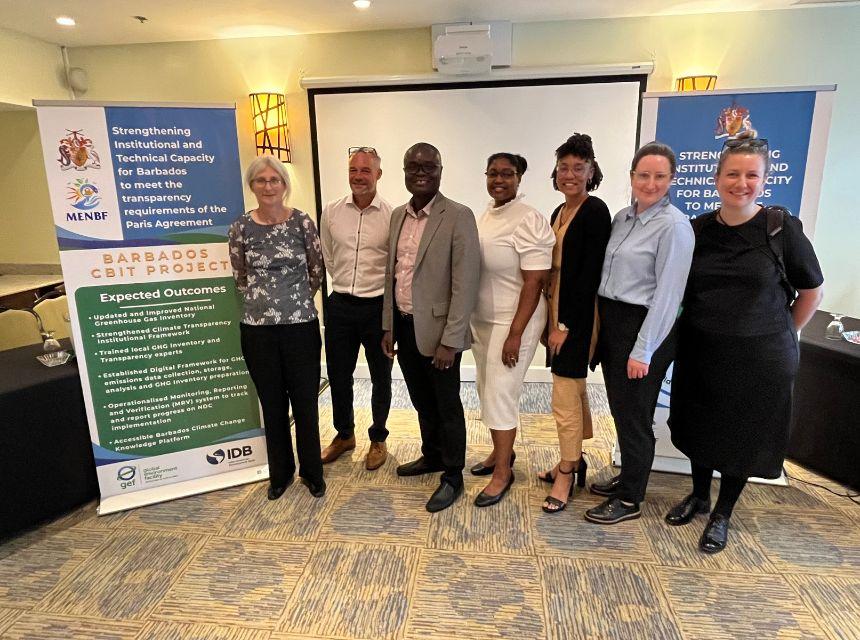
Last month, the Pellucid team — Kwabena Adu, Deborah Best, and Ivanna Odle — spent three days in Bridgetown for the CBIT Project Inception Workshop and Stakeholder Consultations, alongside colleagues from Aether UK (Melanie Hobson, Justin Goodwin and Annie Parker), Jillian Foster from Ridgeway, and local adaptation consultant Judi Clarke. (GlobalFields rounds out the consortium delivering this project, though they weren't at the workshop in person this time.)
For those unfamiliar with the project: Barbados is building a national Monitoring, Reporting and Verification (MRV) system to track its progress against its climate commitments under the Paris Agreement — a project funded through the Global Environment Facility's Capacity Building Initiative for Transparency (CBIT), with the Inter-American Development Bank as implementation partner. Pellucid's role is to design and build the digital platform at the heart of it: the system government agencies, data providers, and reviewers will actually use to collect, manage, and report the country's greenhouse gas data.
This was our first time meeting the full project team and a room full of stakeholders in person, and it was every bit as valuable as we'd hoped. Day one opened with remarks from IDB Chief of Operations Francesco De Simone and Deputy Prime Minister and Minister of Environment Santia Bradshaw, alongside presentations from the CBIT Global Support Programme's Brittany Meighan Rancharan and the Ministry's own project coordinator, Gina Belle. Bradshaw's opening line stuck with us: what a country "cannot measure and cannot properly manage and cannot demonstrate, [it] will find increasingly difficult to finance." That's the whole case for this project in one sentence - and it's exactly the problem our platform is meant to solve.
The two days that meant the most to us, though, were the stakeholder group sessions — eight of them in total, run back-to-back across day two and three, covering nearly every corner of government: energy, transport and industry; agriculture, planning and land use; waste, water and wastewater; coastal zones and fisheries; the social dimensions of climate change (gender, labour, disaster management); climate finance and investment; education and professional development; and the transparency leads who'll ultimately run the system day to day. Hearing directly from that many agencies about their existing processes, their data, and where the friction is today is already shaping how we're designing the platform's interfaces and workflows. There's no substitute for sitting across the table from the people you're building for. Day three closed with a session dedicated entirely to the digital platform itself, walking the Ministry through where development stands and what's coming next.
What struck us most was the tone in the room across all three days: genuine willingness to participate, thoughtful questions, and real expectations for what this platform can do — not just for Barbados' international reporting obligations, but for better decision-making at home. As De Simone noted, this work anchors a broader effort to strengthen how Barbados reports under the Paris Agreement's Enhanced Transparency Framework.
We're grateful to have been part of the room for this — to the Ministry of Environment, National Beautification and Fisheries, to the IDB, to Aether, Ridgeway, GlobalFields, and to every stakeholder who showed up ready to engage. We're looking forward to the work ahead.
You can read more on the workshop from Barbados Today here, and find the workshop agenda and materials on the project's public transparency portal, which Pellucid also built: climatechange.gov.bb/events.
#ClimateTransparency #Barbados #MRV #CBIT #ClimateAction #GEF #IDB #Pellucid
- Log in to post comments